Derived quantities
Some numbers you don't trace; you calculate them from a takeoff you already have. A derived quantity keeps the shapes you drew and reports them in a different dimension: an area becomes a volume or a perimeter, a run becomes wall area.
Updated 2 minApplies to: MapFeedback →
How derivation works
You convert the quantity, not the shape. Open the ⋮ menu on the quantity's row in the Quantities panel and pick a Convert to … option. The conversion covers every measurement in the quantity, and a converted quantity offers the way back (Convert to area).
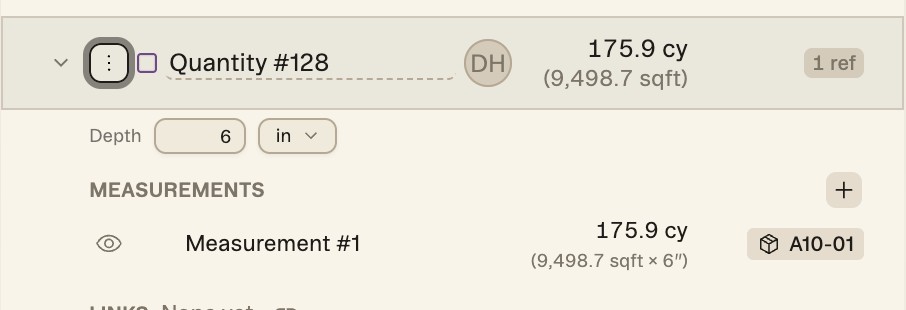
The traced measurement stays underneath as the source, and the row shows both numbers.
From an area
- Convert to volume… asks for a Depth, with its unit, and reports cubic yards. The depth stays editable on the row.
- Convert to perimeter asks for nothing else. It reports the outline length of every area in the quantity, in linear feet.
You can also start there: pick Volume Takeoff or Perimeter Takeoff from the Measurement tool options chevron before tracing. Volume asks for one depth for the session and applies it to every footprint you draw.
Formulas
For anything the Convert options don't cover, choose Set formula… from the row menu. Every measurement in the quantity is re-measured through the expression, replacing its drawn total. A run offers length and adders as inputs; the functions round, ceil, floor, abs, sqrt, min, max and sum are available; and Unit sets what the result is reported in (ea, lf, ly, sqft, sy, cy or cf). Once a formula is set, the menu offers Edit formula….
- Wall area from a run: length 8, Unit sqft*. A 45 lf run at 8′ is 360 sqft.
- Both faces: length 8 2. A partition finished on both sides is one traced run times two.
Good to know — Multiply rather than retrace. A second traced copy is a second thing to keep in step when the drawing changes; a formula is not.
What you see
A converted quantity shows the derived total with the traced source beneath it: 175.9 cy over 9,498.7 sqft. Each measurement row shows the math behind its own number, such as (9,498.7 sqft × 6″), so anyone reading the estimate can see how the figure was made.
Good to know — A derivation belongs to the quantity, not to a single shape. Two footprints that need different depths belong in two quantities.
Tip — Rename before you convert. Slab on grade — 6″ tells the next reader what the depth is without opening the row.
More docs